More difficult grabs, more precise landings: What's changing in Moguls for 2026/27?
Nov 25, 2026·Freestyle
When the FIS Moguls World Cup returns to Ruka (FIN) on 12 December, athletes will face some adjustments to how their performances are evaluated, with new incentives for more demanding aerial tricks and a greater emphasis on controlled landings.
The changes come at the beginning of a new Olympic cycle, following a season that saw Dual Moguls make its Olympic debut at Milano Cortina 2026.
While the fundamentals of the sport remain unchanged, the updated approach to aerial difficulty and landing precision could influence how athletes prepare their runs, particularly when deciding which tricks to perform and how much speed to carry into the jumps.
Basic and advanced grabs: Rewarding greater difficulty
One of the most significant updates for the 2026/27 season concerns grabs, an increasingly popular element of aerial maneuvers in Moguls.
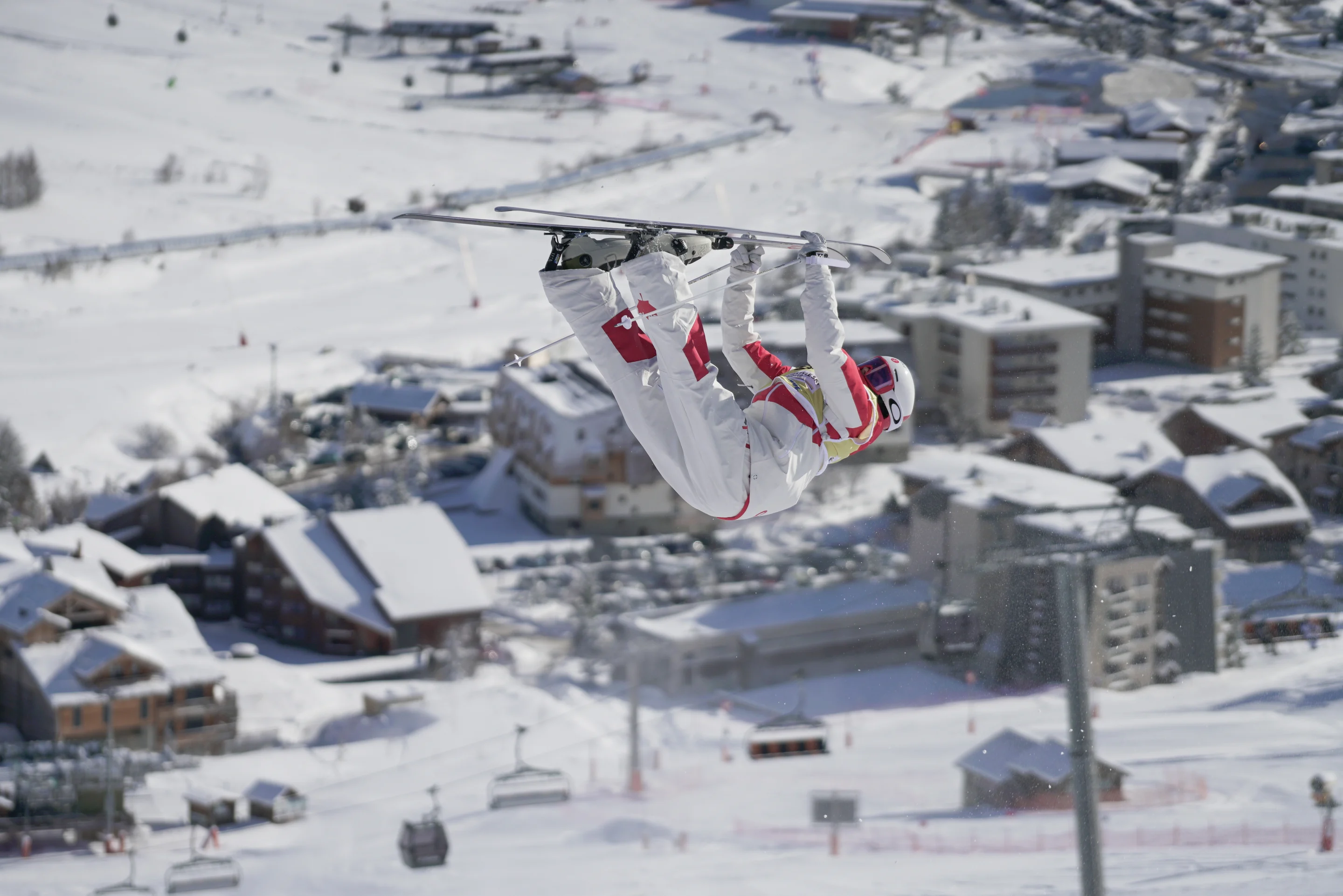
A grab involves an athlete reaching down to hold part of their ski while performing a jump, adding another technical challenge to an already demanding trick.
Previously, grabs were assigned a common degree-of-difficulty value, regardless of their complexity.
Under the updated FIS degree-of-difficulty (DD) table, grabs are now divided into two categories: basic grabs and advanced grabs, each carrying a different difficulty value.
Basic grabs include the safety, Liu Kang and tindy, while advanced grabs include the Japan, mute, high safety, critical, tail, nose, truck driver and venom.
The distinction is designed to better recognize the technical demands of more complex grabs and encourage athletes to incorporate greater variety and difficulty into their jumps.
The difference can be seen in the new DD values.
For example, in the men's competition, a regular 720-degree rotation carries a DD of 0.85. Adding a basic grab increases that value to 0.92, while an advanced grab raises it to 0.99.
In the women's competition, the corresponding values are 0.95 for a regular 720, 1.02 with a basic grab and 1.09 with an advanced grab.
The difference may appear small, but it can have a meaningful impact on the final Air score.
In Moguls, athletes perform two jumps during each run, with their execution scores multiplied by the degree of difficulty of the respective maneuvers.
For illustration, a men's 720 receiving an execution mark of 8.0 would earn 7.36 points with a basic grab, compared with 7.92 for an advanced grab.
That creates an additional incentive to attempt more technically demanding combinations, provided athletes can execute them cleanly.
Importantly, the higher DD does not automatically translate into a better score. A more difficult trick performed with poor form, an incomplete grab or an unstable landing can still score lower than a simpler jump executed well.
The adjustment therefore adds another strategic element to the Air component, encouraging progression without removing the importance of quality and control.
More variety between the two jumps
The updated rules also address how athletes can combine aerial maneuvers during a Moguls run.
Skiers must perform two different jumps to maximize their Air score. While adding a grab can distinguish two otherwise similar maneuvers, the new rules specify that when two jumps from the same category are performed, one with a grab and one without, the lower degree-of-difficulty value is applied to both.
For example, an athlete performing a backflip followed by a similar backflip with a grab cannot simply claim the higher difficulty value for the second jump without the corresponding adjustment.
This provides another incentive to develop two distinct aerial maneuvers rather than relying on closely related combinations.
For spectators, it adds another detail to watch: not only how difficult each individual jump is, but also how athletes build their two-jump program.
Dual Moguls: Putting the focus on controlled landings
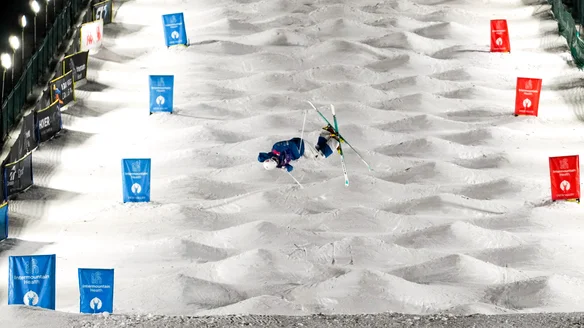
Another important development concerns the bottom jump in Dual Moguls, where athletes compete head-to-head down parallel courses.
Unlike the individual Moguls competition, where skiers focus on maximizing their total score, Dual Moguls introduces the additional pressure of racing directly against an opponent.
This often encourages athletes to carry considerable speed into the final jump, sometimes resulting in jumps that travel beyond the designated landing area.
During the FIS technical meetings earlier this year, the introduction of a so-called chop zone was discussed as a way to address this issue.
The primary objective of this development is to improve athlete safety by encouraging controlled landings within a properly prepared section of the course. It is also intended to provide organizers with clearer guidance when designing and preparing the bottom jump and its landing area, helping ensure that the course meets the demands of modern Dual Moguls competition.
The proposed approach places greater emphasis on landing within the designated area rather than allowing athletes to gain an advantage by carrying excessive speed into the bottom jump.
Under the landing-zone restriction described ahead of the season, athletes who overshoot the designated landing area would risk losing credit for the jump as well as the speed component of their run.
By combining clearer course-design requirements with an emphasis on controlled landings, the aim is to reduce the risks associated with excessive jump distances while maintaining the competitive nature of Dual Moguls.
This could also have an important impact on head-to-head racing, where relatively small differences in speed often influence the outcome.
Athletes may need to adjust their approach through the middle section of the course, controlling their speed earlier to arrive at the final jump with the right combination of momentum and precision.
The challenge will remain the same: ski fast, execute clean turns and deliver technically strong jumps. The additional emphasis on landing distance could make the balance between those elements even more important.
What does it mean for the new season?
The changes do not alter the basic scoring structure of Moguls, where turns account for 60% of the total score, with Air and speed contributing 20% each.
In Dual Moguls, turns, Air and speed remain central to the head-to-head judging process, with a greater emphasis on the latter two components than in individual Moguls.
What changes is how athletes approach certain elements of their runs.
The revised grab values encourage more technical aerial combinations, while the landing-zone approach in Dual Moguls aims to improve athlete safety and help organizers prepare suitable landing areas, while placing greater importance on managing speed and executing the final jump with precision.
With the 2026/27 season beginning in Ruka on 12 December, attention will soon turn to how athletes adapt their technique and aerial programs to the updated rules.
The first Dual Moguls competitions of the winter will provide another opportunity to see how the changes affect head-to-head racing as the World Cup circuit moves into the new Olympic cycle.