

Health Data
Injury & Illness Data
FIS Alpine Skiing Injury and Illness Status 2025–2026
When a serious injury or illness keeps an athlete out of competition for a long time, the athlete can apply to FIS for injury/illness status. If granted, the status protects the athlete´s FIS and/or WCSL points while they recover.
In the 2025/26 season, FIS granted status to 301 athletes in alpine skiing. Together, their applications form a detailed picture of the health problems that take alpine skiers off the snow for long periods. This report shares that picture with athletes, coaches, and the health and technical staff who work with them, along with the wider snow sports community.
FIS Injury Surveillance System: Injury Data (2006-2019)
The FIS Injury Surveillance System was developed prior to the 2006/07 season by FIS in collaboration with the Oslo Sports Trauma Research Center (OSTRC). Athletes were interviewed by research teams at final World Cup events each season.
This report synthesises injury data from the FIS Injury Surveillance System spanning 13 seasons (2006–2019). Across this period, researchers interviewed 11,757 athletes and documented 3,950 injuries requiring medical attention. The surveillance covers Alpine Skiing (World Cup and European Cup), Freestyle Skiing, Snowboarding, and Ski Jumping.
Discipline-Specific Reports
FIS Alpine Skiing Injury Surveillance (2017–2024)
This report draws on injury surveillance data from Alpine Skiing collected through the FIS Single Penalty system.
It is important to understand that this surveillance system captures only the most severe injuries, therefore when athletes sustain injuries severe enough to prevent competition for at least 8 months. These applications therefore form the basis of the analysis.
Data were collected and analysed by University of Innsbruck.
Injury and Illness Surveillance at the 2021 and 2023 FIS Nordic World Ski Championships
The 2021 surveillance covered 344 of 663 registered athletes (51.9 %) through 32 national medical teams; while the 2023 edition covered 596 registered athletes through 29 national teams (over 58 %).
This report pools the two editions into a single overview. The combined analysis base is 940 athletes.
IOC Winter Olympic Games: Focus on Snow Sports
A Pooled Overview and Trend Analysis of Injuries and Illnesses from Four Winter Olympic Games (2010–2022)
Since the 2008 Beijing Summer Olympics, the International Olympic Committee (IOC) has operated a systematic injury and illness surveillance system at every edition of the Games. For winter sports, four consecutive prospective cohort studies have recorded every new injury and illness receiving medical attention during the Games period: Vancouver 2010, Sochi 2014, PyeongChang 2018, and Beijing 2022.
This report focuses exclusively on snow sport disciplines: Alpine Skiing, Freestyle Skiing, Snowboarding, Cross-Country Skiing, Nordic Combined, and Ski Jumping, to offer the snow sports community a practical reference: which disciplines carry the highest risk, what kinds of injuries dominate, and whether the picture is improving or worsening, and where the opportunities for prevention may lie.
Resources & Documents
FIS Survey Injury & Illness Prevention Practices, Needs and Responsibilities
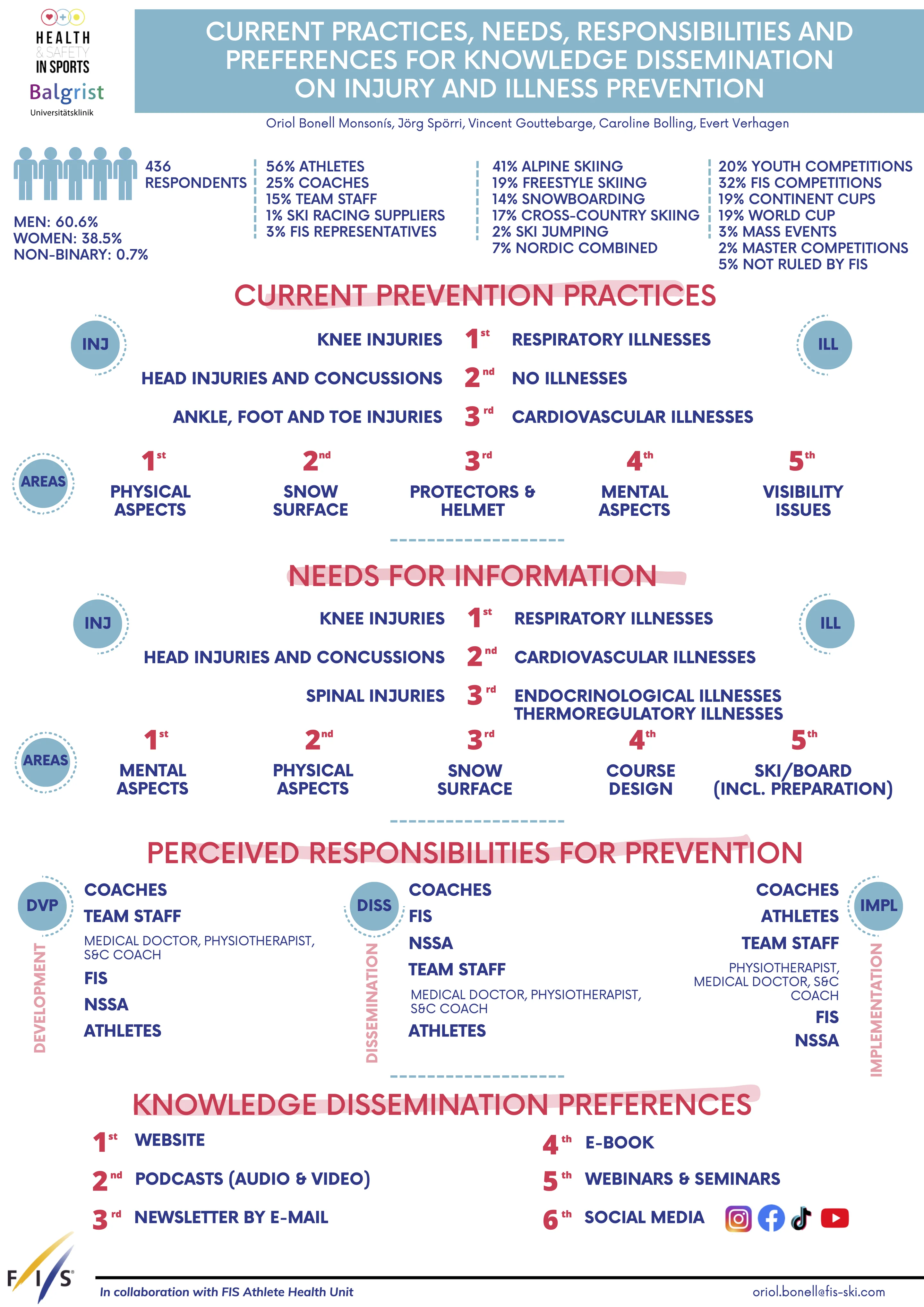
Snow sports stakeholder practices, beliefs, needs, responsibilities, and communication preferences regarding injury and illness prevention in competitive snow sports were surveyed in an online survey during the last quarter of 2023.
This survey included all potential stakeholders in competitive snow sports involved in injury and illness prevention, such as athletes, coaches, health and technical supporting team, ski racing supplier and International Ski and Snowboard Federation (FIS) representatives spanning snow sports governed by FIS, specifically alpine skiing, freestyle skiing, snowboarding, cross-country skiing, ski jumping, and Nordic combined, across all competition levels.
A total of 436 stakeholders responded, representing 23 nations across 5 continents, with 79.4% completing the full survey. Out of the 436 respondents, 56.4% were athletes, 25.1% coaches and 14.7 team staff, while the remainder of the respondents were from the ski racing industry (1.1%) and FIS representartives (2.8%).
See below the written report together with a set of infographics spanning the mentioned FIS snow sport disciplines for a more comprehensive overview of the results.
This work was led by Dr. Oriol Bonell Monsonís (Amsterdam UMC, Netherlands), Professor Jörg Spörri (Bälgrist University Hospital, Switzerland), Professor Evert Verhagen (Amsterdam UMC, Netherlands) and colleagues from the Athlete Health Protection project together with the FIS Athlete Health Unit.
Findings by stakeholders' perspectives
Athletes
Coaches
See below the scientific publication: