

Cool-Down & Recovery
Cool-Down and Recovery Strategies in Competitive Snow Sports
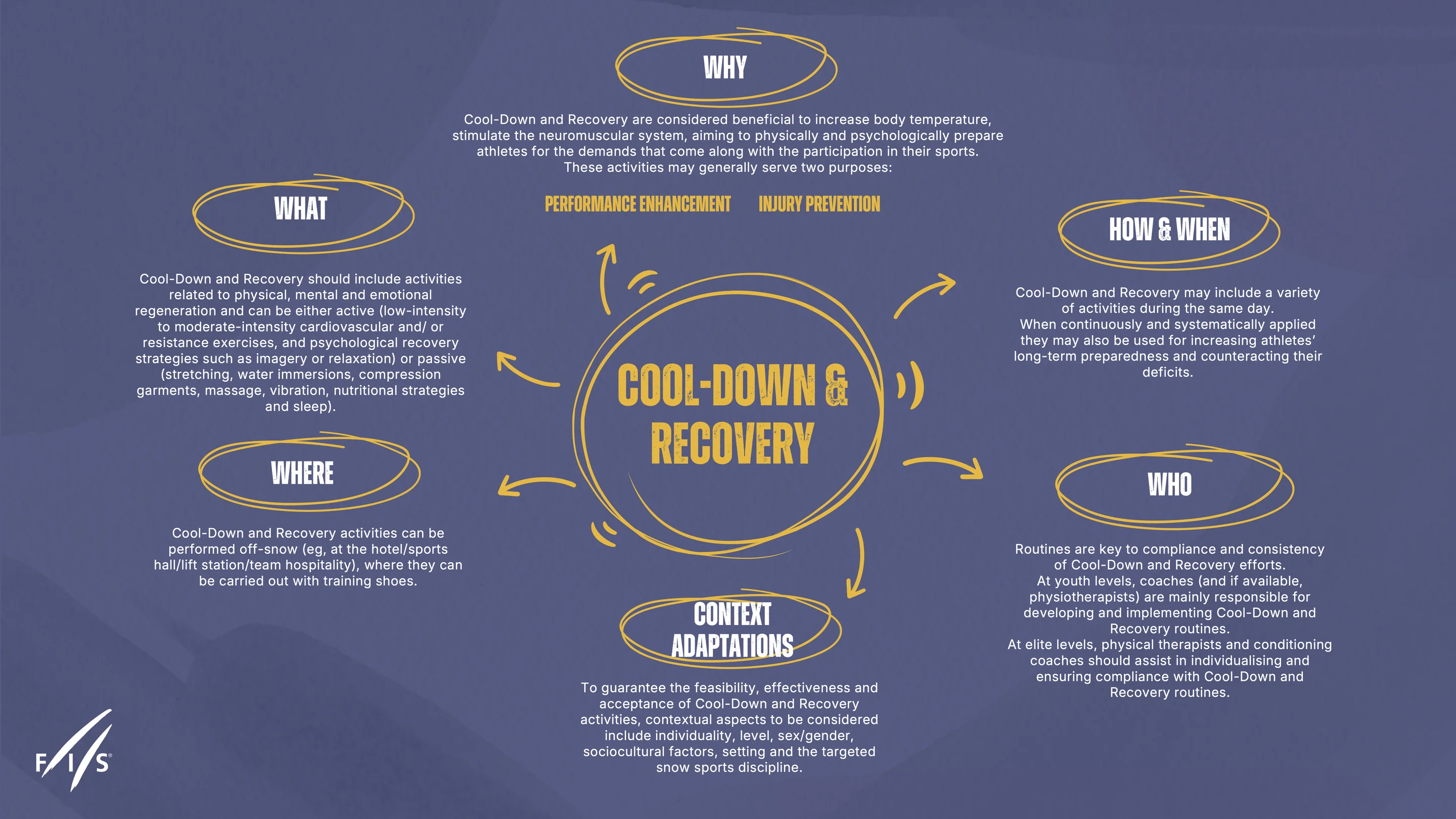
While warm-up focuses on "switching on" the body and mind by upregulating physiological systems, cool-down and recovery aims to achieve the opposite effect: the downregulation of the sympathetic (fight-or-flight) system and the upregulation of the parasympathetic (rest-and-recover) system following training or competition.
In a sport where athletes push their bodies to the limit in challenging environments, effective recovery is what enables sustained high performance across a demanding season.
Core Objectives: Regeneration and Restoration
Key Concepts
Cool-Down
Cool-down aims on the downregulation of the sympathetic system and the upregulation of the parasympathetic system following a training session or competition.
Recovery
Cool-down activities can improve and accelerate this process by targeting a wide variety of interacting factors related to physical, mental, and emotional regeneration. Cool-down activities are classified into two main categories: active recovery and passive recovery.
Active Recovery
Active recovery involves low-to-moderate intensity cardiovascular exercises (such as light jogging or stationary cycling) or resistance exercises performed within after major loading.
The goal is to gradually lower physical and psychological activity levels while maintaining blood flow to facilitate metabolic clearance and initiate effective recovery.
Active recovery helps the body transition from a high-output state to a restorative one.
Passive Recovery
Passive recovery strategies include nutritional interventions, sleep, massage, compression garments, and cold-water immersion.
While there is ongoing debate in the general literature regarding the effectiveness of some specific passive methods, there are also recommendation for their use for snow sports athletes. The challenging environmental conditions (cold temperatures, altitude, and physically demanding terrain) may increase the value of these supportive interventions.
The Role of Cool-Down in Readiness vs. Preparedness
The distinction between Readiness (the immediate state required for performance) and Preparedness (long-term athletic development) applies to cool-down as well as warm-up.
Long-Term Preparedness
There is debate among experts regarding whether cool-down directly increases long-term preparedness. However, in view of the systematic implementation of cool-down protocols may improve training quality, which in turn can enhance long-term performance.
Athletes who recover well can train more consistently, with higher quality, and with fewer interruptions due to illness or injury.
Injury Prevention
Cool-down is linked to reducing the risk of re-injury and facilitating the body's ability to withstand future loads.
Effective cool-down helps maintain all body systems in an operational state, enabling athletes to perform at their limit session after session without accumulating damage that leads to breakdown.
Where and When
A significant practical insight is that immediate cool-down is logistically difficult in competitive snow sports compared to many other sports.
Athletes often finish a run at the bottom of a mountain, far from facilities, and may face time pressure before transport back to accommodation. Despite these challenges, immediate cool-down (when possible) should encompass passive or active reperfusion, controlled breathing to lower respiration, energy restoration, and mental downregulation.
The Recommended Approach
Because immediate cool-down is often impractical, it is recommended to view recovery as broader activities during the same day rather than a single post-exercise window.
Practical examples of cool-down approaches involve a mix of active and passive strategies aimed at both immediate recovery and long-term athlete development, including:
| REPERFUSION |
|---|
| Active or passive methods to restore blood flow to working muscles, helping clear metabolic byproducts and deliver nutrients for repair. |
| It is recommended both as part of an immediate cool-down at the venue and as a broader recovery activity later in the day. |
| Active reperfusion typically involves low- to moderate-intensity cardiovascular exercises performed within approximately one hour after major loading. |
| Passive reperfusion strategies that may support blood flow restoration include massage and compression garments. |
| EXAMPLES: jogging or light running, stationary cycling. |
| DEBRIEFING |
|---|
| A psychological recovery strategy involving the recapitulation and evaluation of the day's performance. |
| Debriefing helps athletes mentally "close" the session, process what happened, and refocus for what comes next. |
| This mental closure is essential for emotional recovery. |
| EXAMPLES: recapitulation and evaluation, planning and refocusing, and communication with the staff. |
| STRETCHING |
|---|
| While stretching after exercise may not enhance immediate recovery, it is recommended for the long-term maintenance of mobility. |
| Preserving range of motion over the course of a season supports both performance and injury prevention. |
| EXAMPLES: post-exercise sessions, injury-specific focus, and long-term maintenance. |
Logistical Barriers
Immediate cool-down is challenging because athletes often do not have access to equipment or facilities at the finish area or immediately after a race. Cold temperatures, transport schedules, and the need for media or team obligations can further compress the available window for recovery activities.
Mental and Emotional Downregulation
The psychological dimension of cool-down should be treated as equally important as the physical dimension. Just as warm-up aims to increase focus and arousal, cool-down aims to reduce mental stressors and allow the mind to recover.
Mental Downregulation
Competition and high-intensity training place significant demands on cognitive resources: attention, decision-making, risk assessment. Mental downregulation involves deliberately reducing cognitive load and allowing the mind to shift out of "performance mode". Without this transition, athletes may carry mental fatigue into subsequent sessions or struggle with sleep and overall wellbeing.
Emotional Regeneration
Strategies such as relaxation techniques, imagery, and self-talk are recommended to help athletes transition out of the high-arousal state required for competition. This is particularly critical where athletes manage the "emotional load" of high-risk, high-consequence performance. Processing the emotions of a competition day is part of healthy recovery.
Impactful Recovery Strategies
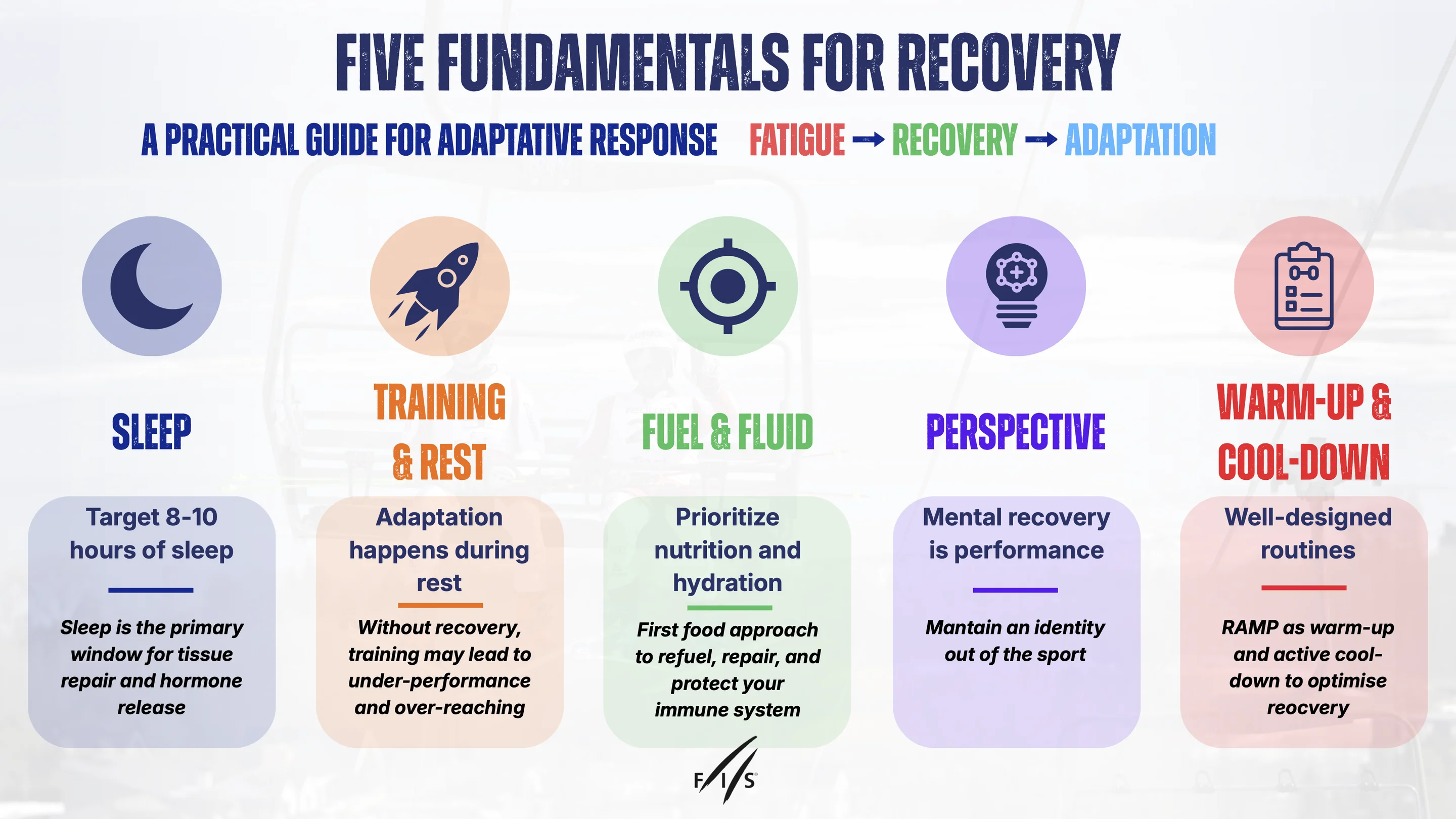
Every hard training session triggers the same physiological cycle: fatigue, recovery, adaptation.
Intense exercise causes short-term fatigue and impaired performance, but once the body fully recovers, beneficial changes occur and the athlete comes back fitter, faster, or stronger. This is the adaptive response, and it is the reason recovery is worth getting right.
Five fundamental strategies drive it, and the same five apply whether we are working with a developing athlete or an Olympic medallist: sleep, balanced training and rest, nutrition, perspective and balance, and warm-up and cool-down. Mastered consistently, they form the base of everything that follows.
Youth Athletes and Routine Formation
An important finding raised by athletes and stakeholders themselves is the discrepancy in how cool-down is perceived by youth versus elite athletes.
Underestimation by Youth
Young athletes often underestimate the importance of cool-down. Many do not fully understand its benefits until they experience an injury or go through an injury cycle.
By the time an athlete learns the value of recovery through negative experience, valuable development time may have been lost.
Building Habits Early: An Educational Mindset
At the youth level, coaches are responsible for implementing cool-down routines and transferring knowledgeabout why recovery matters.
The goal is to make cool-down an "inherent part" of the training process, embedding it in the routine that it becomes automatic. Athletes who develop these habits early carry them throughout their careers, building a foundation of sustainable high performance.
Cool-down may lack the visible excitement of warm-up and competition, but its role in the athlete's journey is equally vital.
By prioritising recovery, both physical and mental, athletes, coaches, and support staff invest in long-term health, consistent performance, and career longevity.