

Return-to-Performance
Return-to-Sport in Snow Sports: Performance, Health, and Risk Management
In competitive snow sports, return-to-sport (RTS) and return-to-performance (RTP) are no longer seen as a simple “yes or no” medical clearance. They are complex, multidimensional processes.
RTP is best understood as a continuous, athlete-centred and biopsychosocial recovery pathway, organised into distinct phases and milestones. Along this continuum, biological, psychological and social aspects are all taken into account. This supports best practice and gives the athlete and the team a shared basis for decision-making.
At its core, the process is shaped by one tension: the drive to maximise performance on one side, and the need to minimise health risks on the other, above all the substantial risk of a subsequent injury.
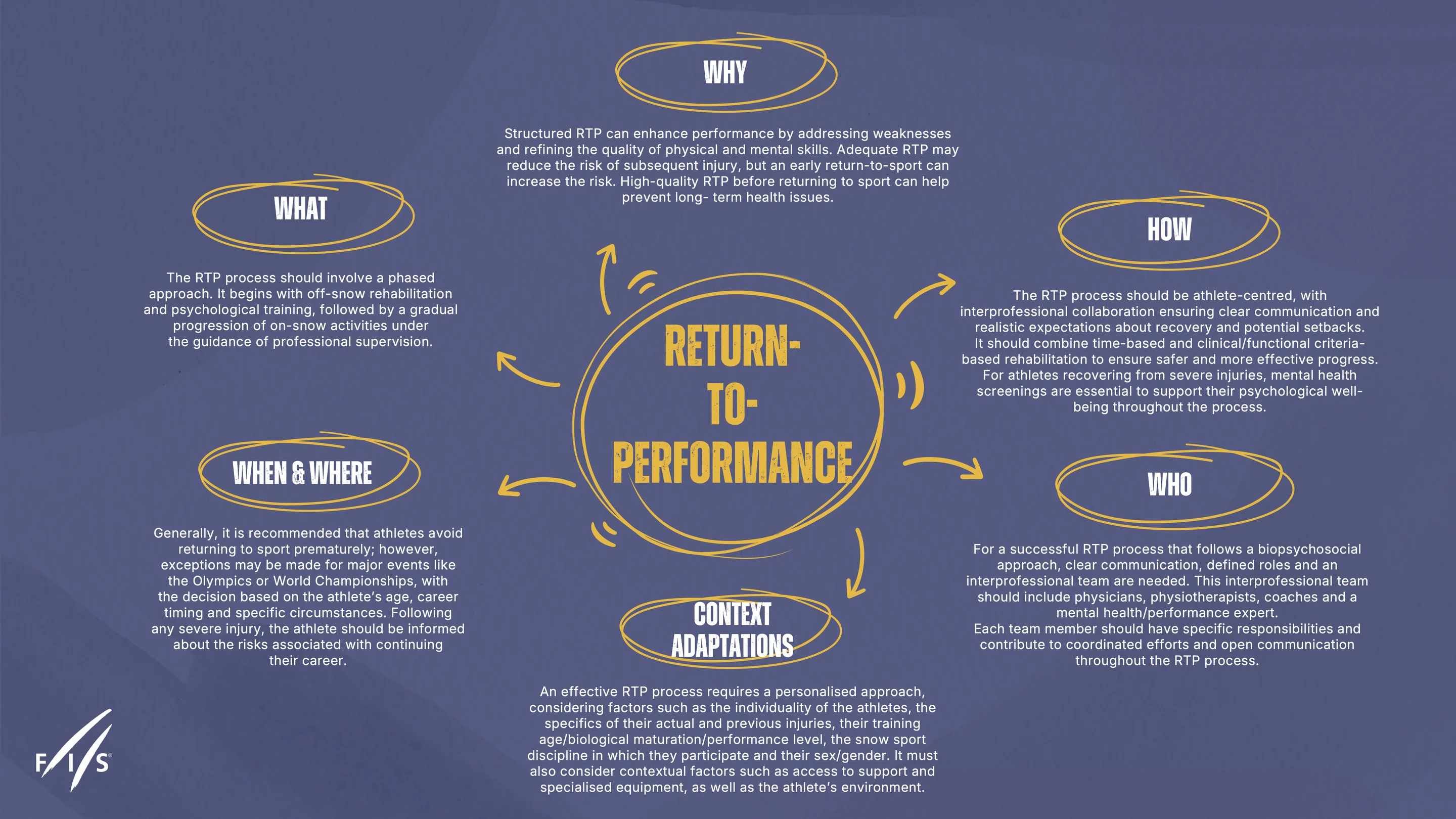
The Goal: Balancing Speed, Safety and Performance
RTS is a continuous, goal-oriented process with a dual aim. In practice, this aim is often complicated by the performance-driven environment of competitive snow sports.
Ultimate goal
RTS should bring the athlete back to competition as fast and as safely as possible. The difficulty is that these two aims pull in different directions, and in a performance-driven environment speed is often prioritised over safety.
Performance recovery
RTS is not only about recovery; it is also an opportunity forperformance enhancement. A well-run RTP can address existing weaknesses and refine the quality of physical and mental skills. Athletes and stakeholders defined the ultimate goal as a return to (pre-injury) performance.
Health protection (risk reduction)
A key reason for investing in an adequate RTP is to reduce the risk of subsequent injury and avoid long-term health problems. Rushing the process may save a few weeks now, but it can cost entire seasons later.
Pillars of Elite Snow Sports Injury Rehabilitation
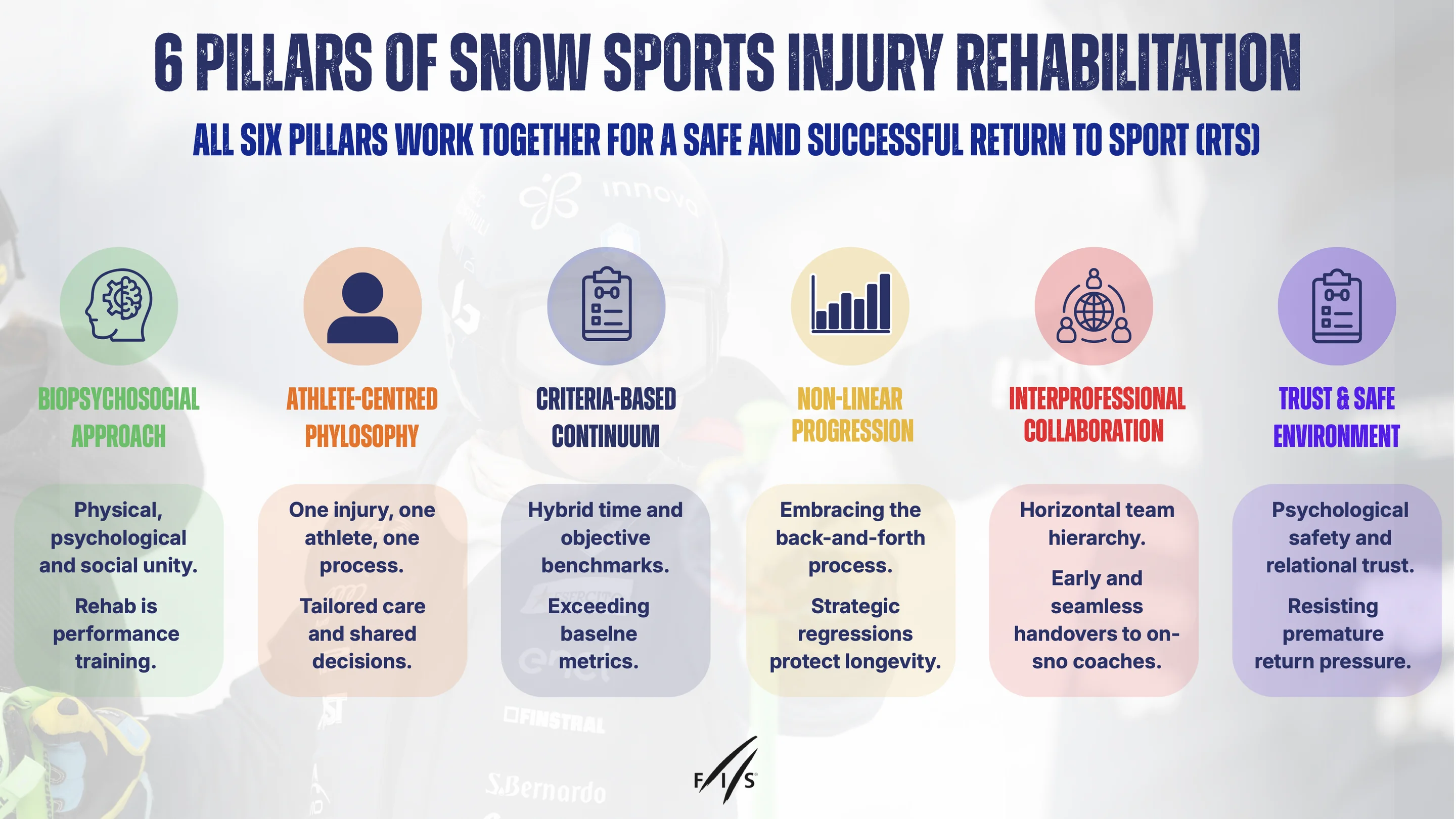
Drawing on the experiences of elite athletes and stakeholders, alongside the International Ski and Snowboard Federation (FIS) consensus guidelines, the core principles behind a modern snow sports RTS framework can be organised into six central pillars.
2. Athlete-Centred Philosophy: “One Injury, One Athlete, One Process”
The framework is anchored in the maxim “one injury, one athlete, one process”.
Individuality
Every injury, career stage and recovery path is unique, so the RTS journey must be tailored to the specific physical, psychological and social needs of the individual athlete. This means taking into account the athlete’s individuality, the specifics of the injury, biological maturation and performance level, discipline and psychological disposition.
Autonomy and education
Athletes must be fully informed about their recovery steps and understand the different phases. This gives them the knowledge and agency to take an active part in shared decision-making. Involving athletes in all decisions is also how trust is built (see Pillar 6).
3. A Structured, Criteria-Based Continuum
Progression through rehabilitation, from the first phases to regular team training, should be structured, criteria-based and monitored through milestones. Objective performance metrics, not the calendar alone, should guide each step.
The problem with timelines
Relying strictly on time-based checkpoints is risky. Calendar timelines are generally rough estimates and often differ from an athlete’s actual biological healing and functional recovery.
The hybrid solution
Best practice combines time-based checkpoints with clinical/functional criteria-based benchmarks, which allows for individual progression within a safer framework than either approach used alone. Time-based checkpoints serve as a minimum guide that respects biological healing time, for example waiting at least 9 months before returning to snow after an anterior cruciate ligament (ACL) reconstruction. They also help to set realistic expectations for the athlete and the team. Criteria-based benchmarks (objective strength, functional and psychological tests) allow for individualised progression and focus on measurable rehabilitation content, which helps to structure the process and guide decisions. Each approach covers the other’s blind spot: time protects healing tissue, while criteria confirm that the athlete is genuinely ready to move on.
Striving for the optimum
When judging performance readiness, baseline data (individual pre-injury or normative values) are used not as the final goal but as a reference point to be exceeded through rehabilitation. This demanding approach can turn the rehabilitation period into an opportunity to raise performance levels, by working on deficits that rarely get attention during a normal season.
Small steps
The overall journey is broken down into small steps and measurable short-term goals. This keeps the athlete motivated and clearly marks physical milestones along the way.
A gap to close
Snow sport-specific objective criteria are often lacking for the later rehabilitation phases, such as on-snow training. This gap matters, because these later phases are where decisions carry the most risk and where we most need reliable tools.
4. Non-Linear Progression: The “Back-and-Forth” Process
Rehabilitation is rarely a straight line, and the framework openly accepts the “recovery rollercoaster” as a normal part of the process.
Realistic expectations
Both athletes and staff need realistic expectations about progression and possible setbacks along the RTP continuum, and should accept that recovery can move both forwards and backwards. The focus should stay on what the athlete needs to do to return fully, rather than only on the RTP outcome itself.
Strategic regressions
If an athlete experiences a physical setback (such as joint swelling) or psychological hesitation, stepping back to a previous phase to resolve the deficit is a normal and smart strategy. It protects long-term joint health and career longevity, and should not be seen as failure.
5. Interprofessional Collaboration and Horizontal Hierarchies
Rehabilitation is rarely a straight line, and the framework openly accepts the “recovery rollercoaster” as a normal part of the process.
Realistic expectations
Both athletes and staff need realistic expectations about progression and possible setbacks along the RTP continuum, and should accept that recovery can move both forwards and backwards. The focus should stay on what the athlete needs to do to return fully, rather than only on the RTP outcome itself.
Strategic regressions
If an athlete experiences a physical setback (such as joint swelling) or psychological hesitation, stepping back to a previous phase to resolve the deficit is a normal and smart strategy. It protects long-term joint health and career longevity, and should not be seen as failure.
6. Building Trust and a Safe Environment
Decisions, risk-taking and physical output are strongly influenced by the quality of the recovery environment.
Psychological safety
When athletes feel comfortable, listened to and emotionally supported, it is easier for them to resist the strong pressure to return too early. This pressure often comes from comparisons with peers, or from sponsors and federations.
Relational trust
High-quality outcomes are built on a solid foundation of trust between the athlete and their network of experts. When athletes trust the team and the benchmarks, they move with greater confidence and much less fear of re-injury.
No single pillar works on its own. A safe and successful return depends on all six together: treating the athlete as a whole person, tailoring the process to them, guiding progression with objective criteria, accepting setbacks, working as one team, and creating an environment where the athlete can trust the process.
RTS Structure, Phases and Criteria: From Principles to Practice
The RTP framework puts these principles into practice through a sequence of phases, each led by a different part of the team. Together, they move the athlete step by step from purely clinical recovery to performance-focused training, across two major domains: rehabilitation and training.
Stakeholders stress the need for this structured, phased approach to manage the risks of moving back to high-load activity. Each phase has its own focus and ends with a clear milestone, and each builds on the one before. Across the whole continuum, six milestones mark the athlete’s progress:
1. Back to Function: basic function is restored after the acute phase, under the lead of the medical team.
2. Back to Activity (Restricted): the athlete can handle daily activities and restricted off-snow training.
3. Back to Snow (Restricted): the athlete returns to controlled, supervised on-snow skiing or snowboarding.
4. Back to Sport (Unrestricted): the athlete resumes sport-specific training close to their usual competition form.
5. Back to Competition: the athlete is ready to face competition stressors and compete safely.
6. Back to Performance: the athlete shows stable competitive performance at or above their baseline.
Moving the athlete successfully from one phase to the next depends on staying true to the core principles of collaboration, communication and criteria-based progression.
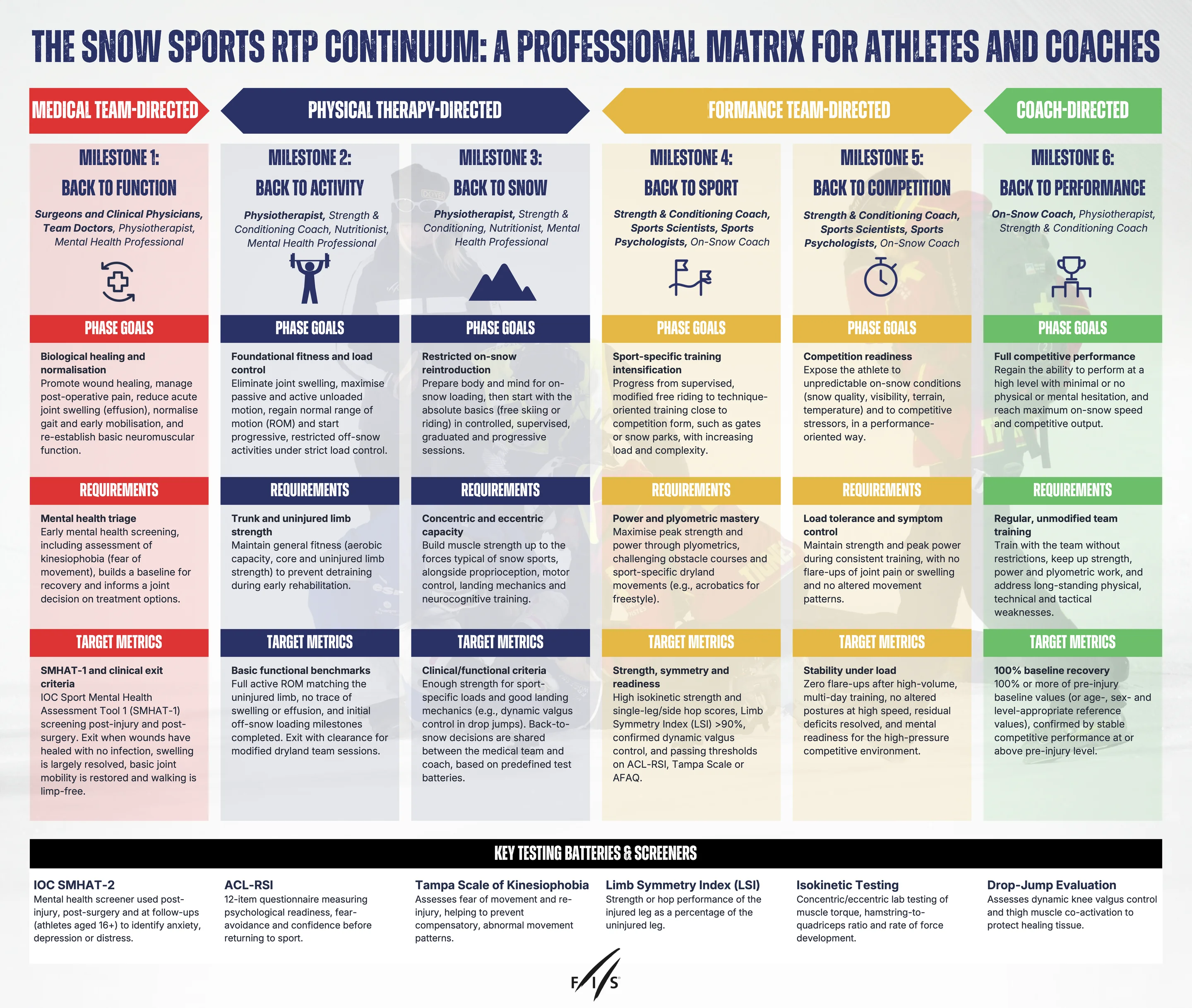
Medical team-directed rehabilitation
Phases: Post-injury, pre-surgery and post-surgery.
Focus: This phase covers immediate care in the acute phase, tailored to the type of injury and the resources available. Key objectives include wound healing, managing pain and reducing swelling, normalising gait, restoring range of motion (ROM) and re-establishing basic neuromuscular function. It also includes assessing mental health, so that the athlete and the team can make a joint decision about treatment options. If surgery is needed, its timing depends on the injury, and decisions should be guided by clinical experts.
Milestone: Back to Function.
Physical therapy-directed rehabilitation
This stage covers the first recovery phases, leading up to the athlete’s return to the sport environment.
Early rehab (return-to-activity)
The objective is to move from early rehabilitation tasks to daily activities and basic functional movement tasks. Work includes eliminating swelling, unloaded motion, maintaining general fitness (aerobic capacity and trunk strength), regaining normal ROM and a progressive build-up of restricted off-snow activities with appropriate load control. Once the return-to-activity decision has been made, the athlete may resume modified dryland sessions with the team, which also helps them stay connected to the group. Milestone: Back to Activity (Restricted).
Mid rehab (return-to-snow)
This phase aims to bring the athlete back to restricted on-snow skiing or snowboarding in a controlled, supervised, graduated and progressive way. Training focuses on building concentric and eccentric muscle strength up to the forces typical of snow sports, alongside proprioceptive and cognitive training and improvements in motor control, landing and dynamic movements. On-snow activity starts with the absolute basics and then progressively adds challenge through sport-specific equipment, slope conditions, terrain, visibility and exercise forms.
Milestone: Back to Snow (Restricted).
Performance team-directed rehabilitation and training
This stage moves the athlete towards full participation and addresses any remaining deficits.
Late rehab (return-to-sport)
In snow sports, return-to-sport means resuming sport-specific training close to the typical competition form, such as training in gates or snow parks. The work involves maximising muscle strength and power, plyometrics, challenging obstacle courses and technique-oriented on-snow training with increasing load. This phase marks the shift from supervised or modified training to unsupervised or unmodified activity. Milestone: Back to Sport (Unrestricted).
Early team training (return-to-competition)
Athletes now prepare for competition stressors and perform their sport in a performance-oriented way, even if their level may still be below pre-injury performance. Training includes maintaining muscle strength and power, regular training without flare-ups of joint pain or effusion, or altered movement patterns, and on-snow training in different conditions. Athletes must not return to competition with significant physical or mental deficits that could affect their safety.
Milestone: Back to Competition.
Coach-directed training
Regular team training (return-to-performance)
At this stage, the athlete skis or snowboards without altered movement patterns or psychological concerns, while continuing strength and plyometric work. The athlete should have reached 100% of their baseline measures or more, or age-, sex- and level-appropriate reference values.
Return-to-performance means regaining the ability to perform at a high level with minimal or no physical or mental hesitation or impairment.
The final goal is an equivalent or higher performance level (physically, mentally, technically and tactically), shown through stable competitive performance.
RTP may therefore happen even after the athlete has returned to competition: being back on the start list does not necessarily mean being back to full performance.
Milestone: Back to Performance.